April 5, 2026 · DealerScout.ai Team
Why Private Seller Vehicles Are Better Deals (and How to Find Them)
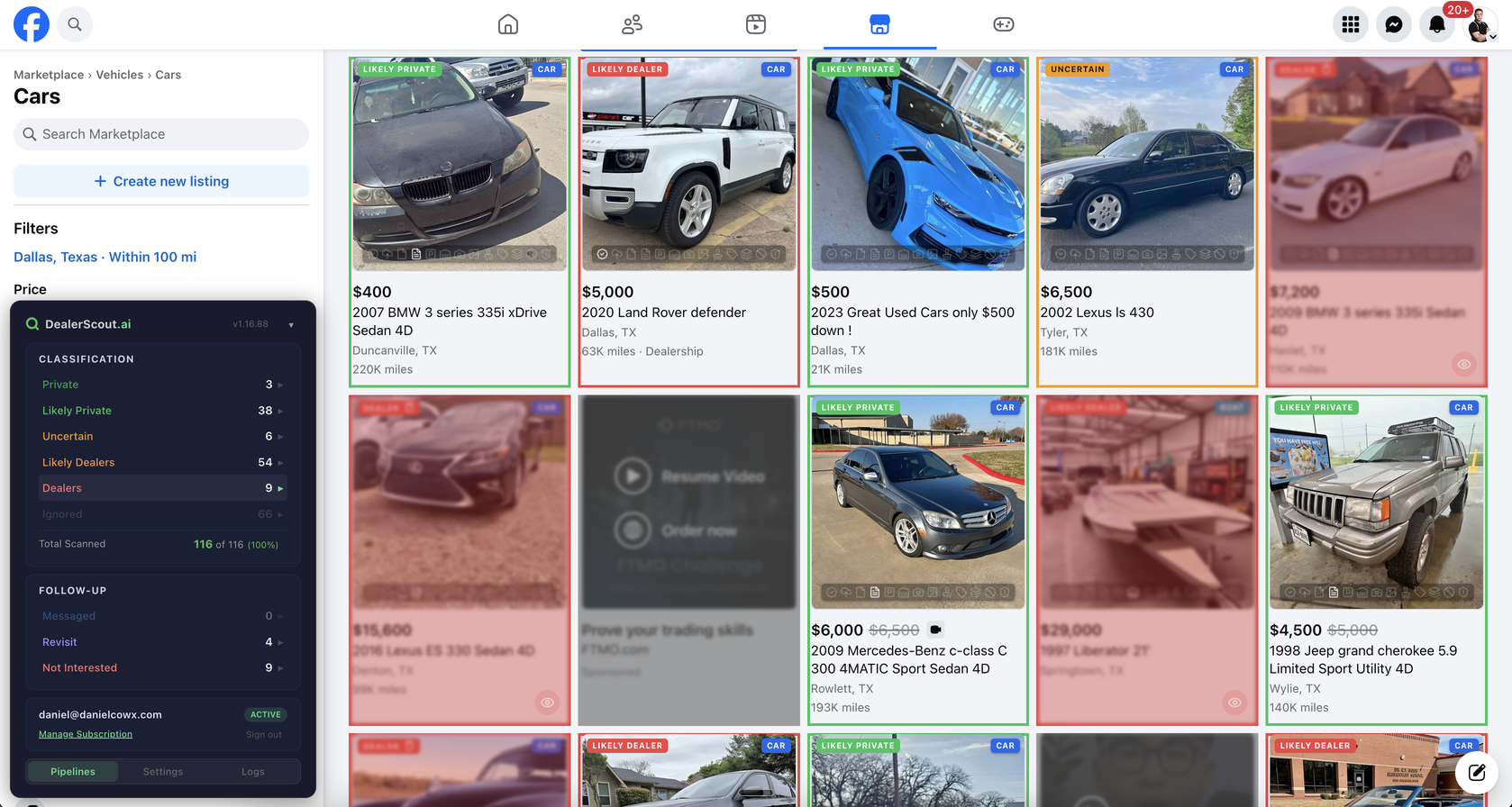
There's a reason savvy car buyers spend hours scrolling Facebook Marketplace instead of walking onto a dealer lot: the deals are better. Significantly better. But only if you're buying from an actual private seller.
The price gap between a private sale and a dealer sale for the same vehicle can range from 10% to 30%. On a $15,000 car, that's $1,500 to $4,500 in your pocket. The question isn't whether private seller deals are better — it's why, and how to make sure you're finding the real ones.
The Price Advantage Is Real
When you buy from a private seller, you're cutting out an entire layer of overhead. Here's where the savings come from:
No dealer markup. Dealerships buy vehicles at wholesale — often at auction for 20-40% below retail — and sell at full market value. Their entire business model is the spread between those two numbers. A private seller bought the vehicle to drive, not to resell for profit.
No dealer fees. Documentation fees, preparation fees, advertising fees, "market adjustment" surcharges. Dealers add $500 to $2,000 in fees that have nothing to do with the vehicle's value. Private sellers don't charge fees.
No sales pressure. A private seller wants to sell the car and move on. They're not trying to upsell you on undercoating, extended warranties, or gap insurance. The negotiation is simpler and more honest.
Motivated sellers. Private sellers often have a reason to sell — upgrading, downsizing, relocating. That motivation translates to flexibility on price. A dealer can afford to wait; a private seller clearing out their second car before a move across the country can't.
Beyond Price: The Hidden Advantages
The financial case is clear, but private seller deals are better in ways that don't show up in the sticker price.
Vehicle history transparency. When you buy from the person who actually drove the car, you can ask questions a dealer can't answer: "Has it ever been in an accident?" "When was the timing belt last done?" "Why are you selling?" A private seller who maintained the vehicle for five years knows its history intimately. A dealer who bought it at auction last Tuesday does not.
No reconditioning markup. Dealers "recondition" vehicles before sale — detailing, minor repairs, touch-up paint. This costs them a few hundred dollars, but they bake thousands into the price to cover it. A private seller's car may not be showroom-clean, but you're not paying a premium for the polish.
Direct negotiation. There's no sales manager in the back room. No "let me talk to my manager" theater. You're sitting across from one person who owns the car. The conversation is straightforward: what's the car worth, what are you willing to pay, can you meet in the middle?
The Challenge: Finding Real Private Sellers
Here's the catch. Facebook Marketplace is flooded with dealers listing under personal profiles. Some studies suggest that 30-50% of vehicle listings on Marketplace come from commercial sellers operating as individuals.
These listings look private at first glance. The seller has a personal Facebook profile. There's no "dealership" label. But behind the scenes, they're buying vehicles at auction, doing minimal work, and flipping them for profit — with all the markup and none of the accountability of a licensed dealer.
So how do you filter them out?
Check the seller's other listings. This is the single most reliable manual check. Click the seller's name. If they have multiple vehicles listed simultaneously, they're almost certainly running a commercial operation.
Look at the photos. Private sellers take photos in their driveway with their phone. Dealers use consistent lighting, backgrounds, and angles. Professional photography is a strong dealer signal.
Read the description style. Templated, marketing-style descriptions with bullet-pointed features, financing mentions, or warranty offers are commercial. Private sellers write like humans: casual, specific, sometimes rambling.
Use automated detection. This is where DealerScout.ai comes in. The extension analyzes every listing in real time against 13 dealer signals — seller inventory, photo analysis, pricing patterns, description style, and more. Each listing gets an instant Private, Dealer, or Uncertain classification so you can focus on the real private-seller deals without the manual detective work.
The Bottom Line
Private seller vehicles are better deals because you're cutting out the middleman's margin, fees, and sales overhead. The savings are real and substantial — easily thousands of dollars on a typical used car purchase.
The hard part isn't making the case for private sellers. It's finding them on a platform where dealers are actively disguising themselves as individuals. Whether you do it manually or with AI assistance, the ability to distinguish private sellers from dealers is the most valuable skill a Marketplace car buyer can develop.