April 6, 2026 · DealerScout.ai Team
How to Spot Dealers on Facebook Marketplace (and Why It Matters)
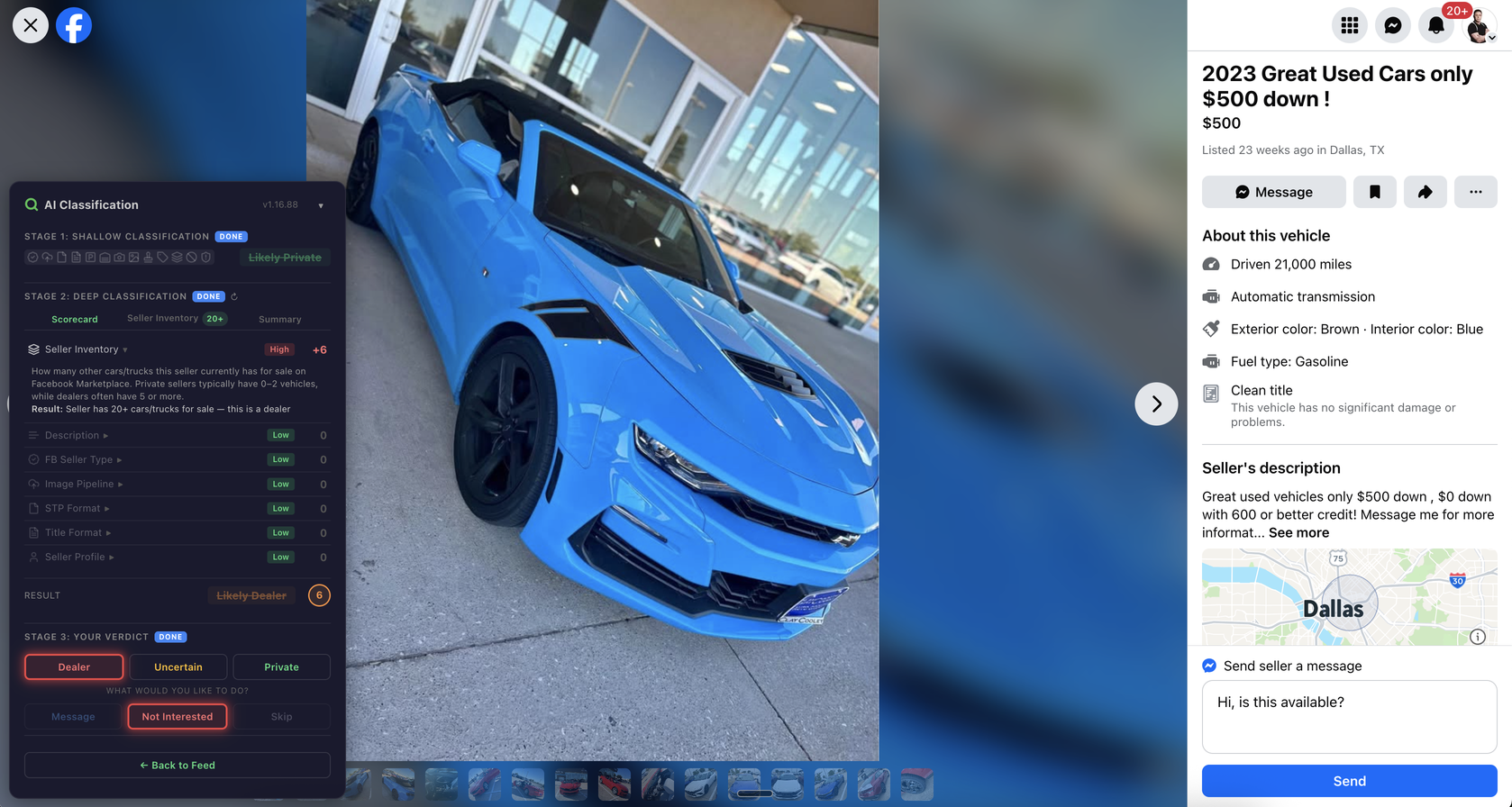
If you've spent more than ten minutes browsing vehicles on Facebook Marketplace, you've probably noticed something: a lot of "private sellers" don't feel very private. The photos are too polished. The descriptions read like ad copy. And when you click on the seller's profile, they have fifteen other vehicles listed.
That's because many of the listings you see on Facebook Marketplace aren't from private individuals at all — they're from dealerships and wholesale operators listing inventory under personal accounts. Understanding how to spot these listings is the single most important skill for any buyer looking for a genuine private-seller deal.
Why Dealers List as "Private Sellers"
Facebook Marketplace allows both dealers and individuals to list vehicles. But many dealers choose to list under personal profiles instead of business pages. The reasons are straightforward:
- Lower fees. Facebook charges commercial sellers differently than individuals. Listing under a personal account avoids those costs.
- More trust. Buyers on Marketplace are often looking to avoid the dealership experience. A listing that appears to come from an individual feels more approachable.
- Less regulation. Commercial vehicle sales come with disclosure requirements in many jurisdictions. Operating as a "private seller" can sidestep some of those obligations.
- Better visibility. Facebook's algorithm tends to surface local, personal listings prominently. Dealer inventory listed under a business page may get less organic reach.
None of this is necessarily illegal, but it puts buyers at a disadvantage. You think you're negotiating with someone selling their personal car, when you're actually dealing with a professional who buys and flips vehicles for profit.
10 Signs a Listing Is from a Dealer
Here's what to look for. Any single sign doesn't guarantee a dealer, but when you see three or more together, the odds are high.
1. Multiple vehicles from the same seller. This is the strongest signal. Click the seller's name and check their other listings. If they have five, ten, or twenty vehicles for sale, they're running a business — not cleaning out the garage.
2. Professional photography. Dealers use consistent photo setups: same background, same angles, good lighting. Private sellers take photos in their driveway with their phone. If every shot looks like it belongs in an ad, it probably is one.
3. Stock photos or watermarks. Some dealers pull images from auction sites or manufacturer galleries. Look for watermarks, unusually high resolution, or images that don't match the described condition.
4. Price formatting patterns. Dealers love psychological pricing: $14,999, $8,995, $22,900. Private sellers are more likely to list round numbers: $15,000, $9,000, $23,000. It's a small tell, but it's consistent.
5. Generic or templated descriptions. Dealers often use copy-paste templates across listings. If the description reads like marketing copy with bullet-pointed feature lists, warranty mentions, or financing offers, it's commercial.
6. No license plates visible. Dealers frequently photograph vehicles with plates removed or obscured. Private sellers usually don't bother — the plates are still on the car they drive every day.
7. Showroom or lot backgrounds. Look at what's behind the vehicle. A paved lot with other cars lined up? An indoor showroom? A commercial building? These are dealer environments, not someone's home.
8. Facebook's own "dealer" flag. Facebook actually categorizes some sellers as dealers internally. This metadata isn't always visible to buyers in the UI, but it's there in the underlying data.
9. Seller profile dominated by vehicle listings. A private seller's Facebook profile has photos of their family, posts about their life, and maybe one or two vehicle listings. A dealer's profile is almost entirely vehicles, posted in rapid succession.
10. Windshield stickers or dealer decals. Zoom into the photos. Dealer inventory often has price stickers on the windshield, dealer logo decals on the trunk, or key tags hanging from the rearview mirror.
Why It Matters
You might be thinking: "So what if it's a dealer? A good deal is a good deal." That's fair — but knowing whether you're dealing with a professional changes the equation in important ways.
Price. Dealers buy vehicles at wholesale (often at auction) and mark them up for retail. A private seller is typically asking closer to actual market value because they're not building in a profit margin. When you know you're dealing with a dealer, you know there's more room to negotiate.
History. Private sellers usually know the vehicle's history because they lived it. Dealers may have limited knowledge of a vehicle they bought at auction last week. Ask detailed questions about maintenance and ownership — a private seller will have answers; a dealer may not.
Negotiation dynamics. Negotiating with a professional is a different game than negotiating with an individual. Dealers have standard objection-handling scripts. They know the anchoring tricks. Going in aware of this gives you an edge.
Legal protections. In many jurisdictions, commercial vehicle sales come with implied warranties and disclosure requirements that don't apply to private sales. If a dealer is operating as a private seller, they may be skirting obligations that exist to protect you.
How AI Automates Dealer Detection
Manually checking every listing against the signals above is tedious. You'd spend more time investigating sellers than actually shopping for a vehicle.
This is the problem DealerScout.ai was built to solve. The extension runs directly in your browser while you browse Facebook Marketplace, analyzing every listing in real time against 13 distinct dealer signals — including seller inventory count, photo analysis, pricing patterns, description formatting, and Facebook's own seller metadata.
Each listing gets an instant classification: Private, Dealer, or Uncertain. You see the result as a color-coded badge right on the listing card, so you can focus your time on the listings that are actually from private sellers.
The scoring isn't binary. A transparent scorecard breaks down exactly which signals fired and how confident the classification is. If you disagree with the AI's call, you can override it with a single click.
What to Do When You Spot a Dealer
Spotting a dealer doesn't mean you should skip the listing. It means you should adjust your approach:
- Negotiate harder. There's margin built into the price. Don't accept the first number.
- Ask for documentation. Request a vehicle history report, maintenance records, and proof of ownership. Professional sellers should have these ready.
- Check for dealer licensing. If someone is operating as a dealer without proper licensing, that's a red flag beyond just pricing — it may indicate they're cutting other corners too.
- Compare to private seller prices. Use the dealer listing as a data point, but look for equivalent private-seller listings at lower prices.
- Know your rights. If the seller is actually a licensed dealer operating under a personal profile, consumer protection laws may still apply to the transaction.
The used vehicle market on Facebook Marketplace is enormous — and growing. Millions of listings go up every month. The vast majority of buyers have no way to quickly distinguish a professional operation from a genuine private seller. The ten signals above give you a manual framework. Tools like DealerScout.ai give you an automated one.
Either way, the goal is the same: spend your time on listings where you have a real shot at a fair, private-seller deal.