April 3, 2026 · DealerScout.ai Team
7 Facebook Marketplace Car Scams (and How to Avoid Every One)
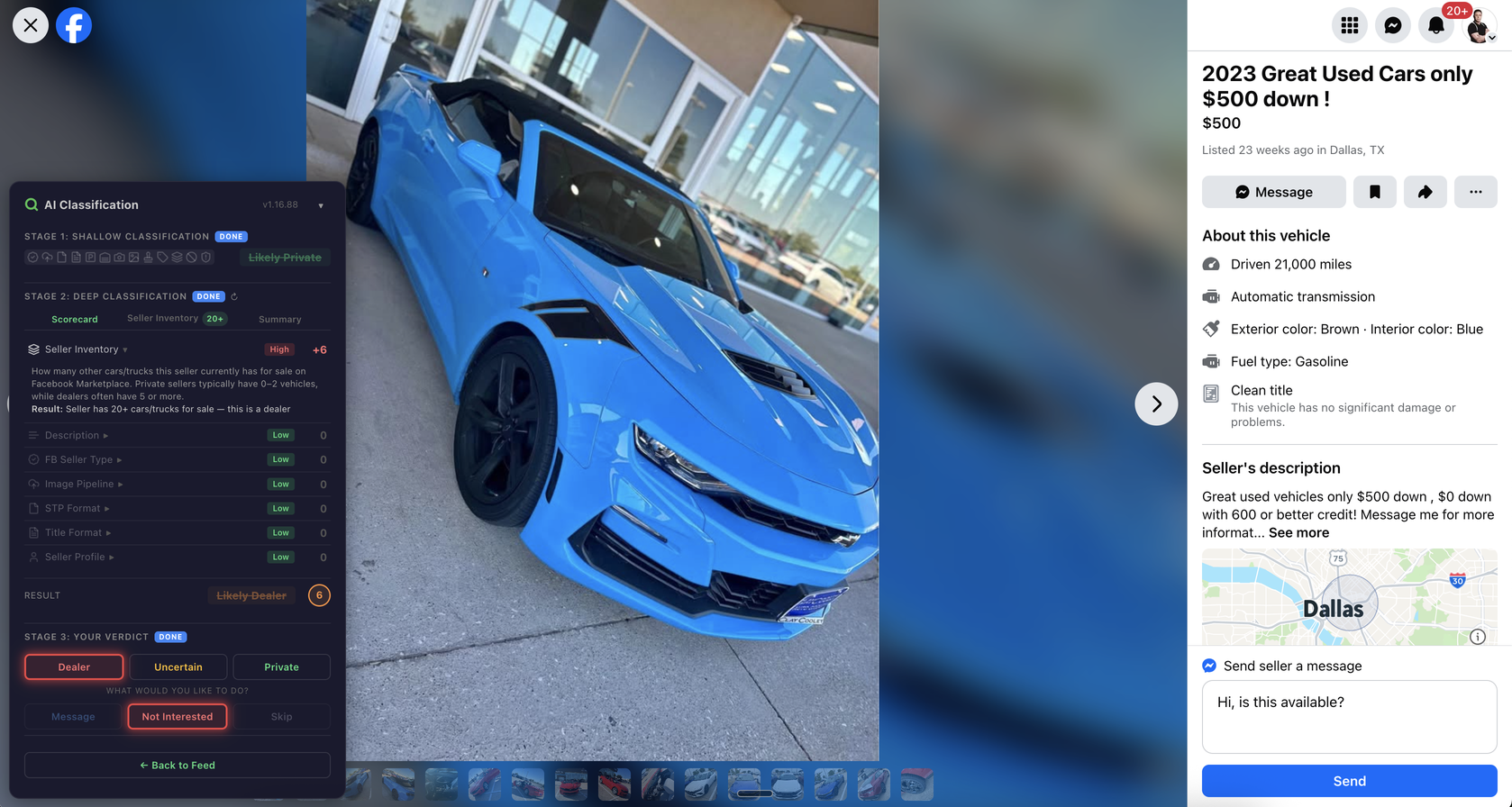
Facebook Marketplace is a legitimate platform for buying and selling vehicles. But its size and accessibility also make it a target for scammers. The good news: nearly every vehicle scam follows a predictable pattern. Once you know what to look for, they're easy to avoid.
Here are the seven most common scams, how they work, and what to do about each one.
1. The Too-Good-to-Be-True Listing
How it works: A late-model vehicle with low mileage is listed at 30-50% below market value. The photos look great. The description is detailed. Everything seems perfect — except the price makes no sense.
When you message the seller, they have a story: military deployment, divorce, relocating overseas. They can't meet in person but offer to ship the vehicle. They'll send you a link to a "secure payment portal" or an "eBay Vehicle Protection Plan" that doesn't actually exist.
How to avoid it: If the price is dramatically below market with no credible explanation, it's a scam. Real sellers with real vehicles price them near market value because they know what their car is worth. Walk away from any listing where the seller can't meet in person.
2. The Curbstoner
How it works: A curbstoner is an unlicensed dealer operating as a private seller. They buy vehicles at auction — often ones with hidden damage, salvage history, or odometer rollbacks — and flip them from a personal Facebook account.
The danger isn't just the markup. Curbstoners often skip legally required disclosures. That "clean title" vehicle may have been totaled in another state and had its title washed. The "130,000 miles" on the odometer may actually be 230,000.
How to avoid it: Check the seller's other listings. If they have multiple vehicles for sale, they're operating commercially. Pull a vehicle history report using the VIN before committing. DealerScout.ai automatically flags sellers with high inventory counts — one of the strongest curbstoner signals.
3. The Title Scam
How it works: The seller lists a vehicle they don't actually own, or owns but has a lien on. You pay, they hand you a title that's either fraudulent, in someone else's name, or has an undisclosed lien. When you try to register the vehicle, the DMV rejects it — and the seller has disappeared.
Variations include:
- Title jumping: Seller bought the vehicle but never registered it in their name, so the title still shows the previous owner
- Lien hiding: Seller still owes money on the vehicle. The lienholder is the legal owner.
- Title washing: Vehicle was totaled in one state, then re-registered in a state with weaker title branding laws to remove the "salvage" designation
How to avoid it: Always check the title before paying. The seller's name must match the name on the title. Run the VIN through the NMVTIS (National Motor Vehicle Title Information System) to check for salvage history, flood damage, and title brands across all states. If the seller says the title is "at the bank" or "being mailed," don't proceed until you see it.
4. The Deposit Scam
How it works: You find a good listing and message the seller. They say multiple people are interested and ask for a deposit — usually via Venmo, Zelle, or Cash App — to "hold" the vehicle. You send the deposit, and the seller either ghosts you or keeps delaying the meetup.
Some versions are more sophisticated: the seller actually shows you the vehicle, takes a deposit to "take it off the market while you get financing," then sells it to someone else who pays in full — and claims your deposit was "non-refundable."
How to avoid it: Never send money before seeing the vehicle in person. No legitimate private seller needs a deposit to hold a vehicle for a day or two. If you do agree to a deposit, make it contingent on inspection and get the terms in writing via Messenger.
5. The Odometer Rollback
How it works: The seller tampers with the odometer to show lower mileage, then prices the vehicle based on the false reading. Digital odometers are harder to roll back than mechanical ones, but it still happens — especially on vehicles imported from other markets or ones that have been through multiple owners.
A vehicle showing 80,000 miles that actually has 180,000 miles may seem like a good deal at $12,000. At its real mileage, it might be worth $6,000 — and the engine could be near end of life.
How to avoid it: Pull a vehicle history report. Services like Carfax track odometer readings from inspections, service visits, and registration events. If the recorded history shows a mileage drop at any point, the odometer has been tampered with. Also look for physical signs: excessive wear on the steering wheel, pedals, and seat that doesn't match the claimed mileage.
6. The Mechanical Lemon
How it works: The seller knows the vehicle has a serious mechanical problem — a failing transmission, a cracked engine block, a chronic electrical issue — but doesn't disclose it. They may time the listing for warm weather (cold start problems don't show up), keep the engine running before you arrive (masks startup issues), or park on a slope (hides transmission problems on flat ground).
How to avoid it: Get a pre-purchase inspection from an independent mechanic. This costs $100-200 and takes about an hour. The mechanic will check compression, transmission behavior, suspension, electrical systems, and overall condition. This single step catches the majority of hidden mechanical problems.
Also: always test-drive the vehicle yourself. Start it cold. Drive on the highway. Test the brakes hard. Run the A/C. If the seller makes excuses about why you can't do any of these things, that's your answer.
7. The Fake Escrow / Payment Redirect
How it works: The seller (who may or may not have a real vehicle) directs you to a third-party "escrow" service or payment platform. The site looks professional but is entirely fake — designed to capture your payment information or accept a wire transfer that goes directly to the scammer.
Some variations involve the seller claiming they'll ship the vehicle and suggesting an "eBay Motors" or "Facebook Buyer Protection" escrow service. Neither platform offers this type of service for private vehicle sales.
How to avoid it: Never use a payment service suggested by the seller. Cash and cashier's checks at a face-to-face meeting are the standard for private vehicle sales. eBay Motors does not provide escrow for Facebook Marketplace transactions. Facebook does not offer buyer protection for vehicle sales. Any link to such a service is fraudulent.
The Common Thread
Every scam on this list shares one trait: they exploit the gap between what you see and what's real. The listing looks legitimate, but the vehicle doesn't exist. The title looks clean, but it's been washed. The mileage looks low, but it's been rolled back. The seller looks private, but they're a commercial operator.
Closing that gap is straightforward:
- Verify everything independently. Don't rely on the seller's claims. Pull the VIN report. Check the title. Get the inspection.
- Meet in person. No exceptions. Any seller who can't meet face-to-face for a vehicle transaction is not worth your time.
- Pay securely. Cash or cashier's check at the time of title transfer. Nothing else.
- Trust your instincts. If something feels off, it probably is. There are always more listings.
Tools like DealerScout.ai add an extra layer by automatically identifying commercial sellers operating as private individuals — one of the most common precursors to curbstoning and other scams. But even without automated tools, the seven patterns above are your playbook. Learn them, and you'll buy with confidence.