April 4, 2026 · DealerScout.ai Team
The Complete Guide to Buying a Car on Facebook Marketplace in 2026
Facebook Marketplace has quietly become one of the largest used car marketplaces in North America. Millions of vehicles are listed every month, and for buyers willing to do their homework, the deals are often better than what you'll find on traditional platforms like AutoTrader or Cars.com.
But buying a car on Marketplace is different from buying on a dedicated auto site. There are no built-in vehicle history reports, no standardized inspection processes, and no platform-enforced buyer protections. You're on your own — and that's exactly why preparation matters.
This guide covers every step of the process, from your first search to handing over the cash.
Step 1: Set Up Your Search
Facebook Marketplace's vehicle search has improved significantly, but it still requires some strategy.
Location matters. Marketplace defaults to your current city, but you can expand the radius. For the best selection, search within a 50-100 mile radius. Going further than that adds travel cost and complexity.
Use category filters. Navigate to Marketplace, then select "Vehicles" to access vehicle-specific filters: make, model, year range, price range, mileage, and transmission type. These filters are more reliable than keyword searches.
Sort by newest. The best deals don't last. Sorting by "Date Listed: Newest First" lets you catch fresh listings before other buyers.
Save your search. Facebook lets you save searches and get notifications when new listings match your criteria. Set this up for your target vehicles and check notifications daily.
Step 2: Evaluate Listings Before You Message
Not every listing deserves your time. Develop a quick screening process.
Photos tell the story. Good listings have 8+ clear photos showing the exterior from all angles, the interior, the dashboard with mileage displayed, the engine bay, and the tires. Listings with one or two blurry photos are either hiding something or not worth the seller's effort — either way, move on.
Read the description carefully. Look for specifics: maintenance history, reason for selling, known issues. The best private sellers are upfront about imperfections. Vague descriptions like "runs great, must see" tell you nothing.
Check the price against market value. Use Kelley Blue Book or Edmunds to look up the fair market value for the year, make, model, mileage, and condition. If the listing price is significantly below market, it's either a great deal or a scam — proceed with caution.
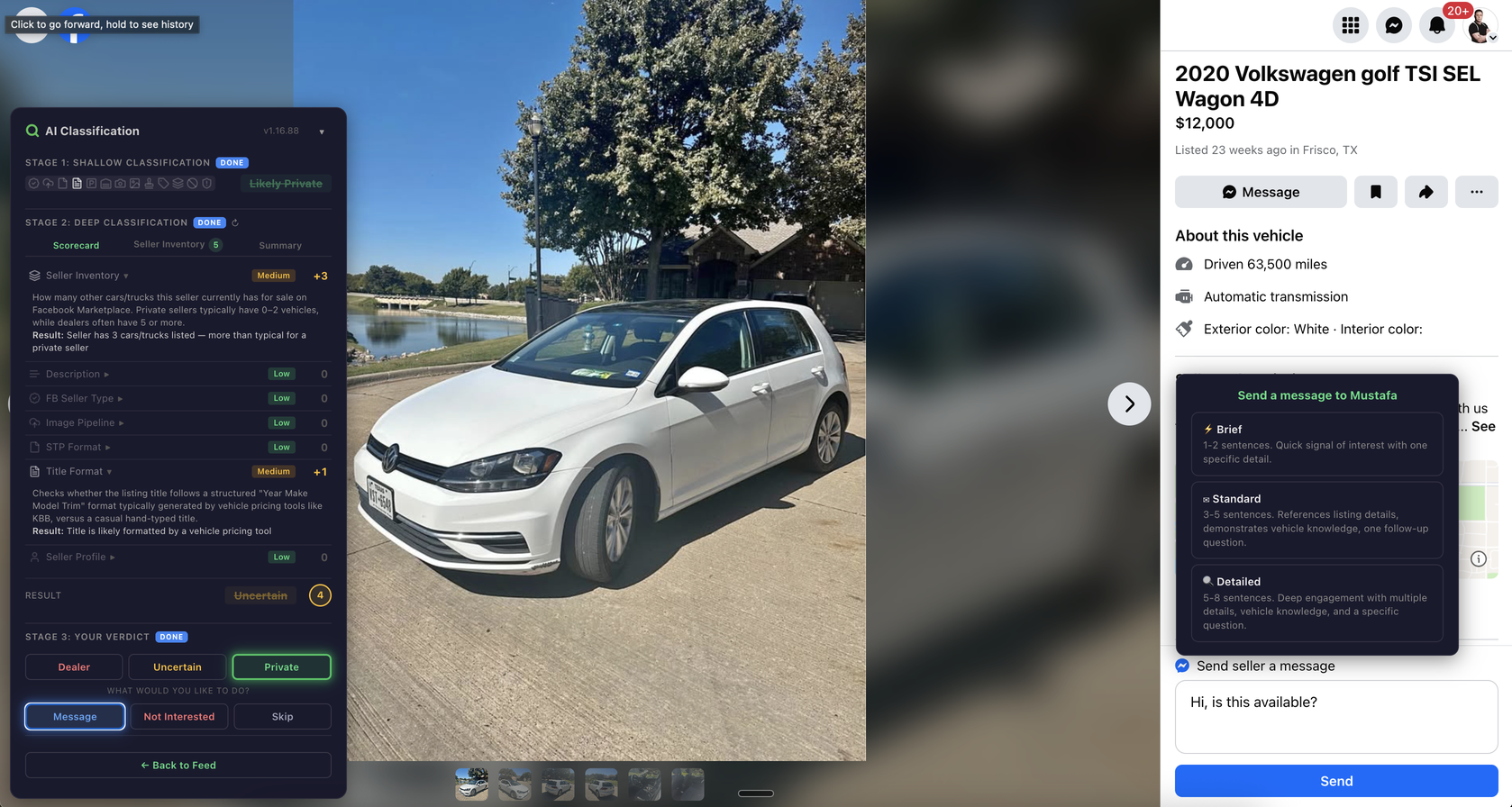
Identify the seller type. Is this a private seller or a dealer? Dealers often list under personal profiles on Marketplace. Check the seller's other listings — if they have multiple vehicles for sale, they're likely a commercial seller. Tools like DealerScout.ai automate this check across every listing.
Step 3: Make Contact
Once you've found a listing worth pursuing, reach out through Messenger.
Be specific. Don't send "Is this still available?" — everyone sends that and it marks you as a low-effort buyer. Instead, reference the vehicle and ask a targeted question: "I'm interested in the 2018 Civic. Can you tell me about the maintenance history and whether the timing belt has been replaced?"
Ask for a VIN. Request the Vehicle Identification Number early. You'll use this to pull a vehicle history report (Carfax, AutoCheck, or a free NMVTIS check). A seller who refuses to provide the VIN is a red flag.
Confirm basic details. Year, mileage, clean title (not salvage or rebuilt), any accidents, mechanical issues. Get these confirmed in writing via Messenger before scheduling a viewing.
Step 4: Inspect the Vehicle
Never buy a vehicle sight unseen. The inspection is where good deals are confirmed and bad deals are caught.
Bring a checklist. Walk around the exterior checking for paint inconsistencies (possible accident repair), uneven panel gaps, tire wear patterns, and rust. Inside, check every button, switch, window, and lock. Start the engine cold — a warm engine can mask problems.
Take a test drive. Drive on local roads and the highway. Listen for unusual sounds. Test the brakes at various speeds. Check that the transmission shifts smoothly. Pay attention to the steering — it should track straight without pulling.
Get a pre-purchase inspection. This is the single most important step most buyers skip. A mechanic's inspection costs $100-200 and can reveal thousands in hidden problems. Many mobile mechanics will come to the seller's location. If the seller refuses an inspection, walk away.
Check the VIN physically. The VIN on the dashboard, driver's door jamb, and title should all match. Mismatched VINs indicate a serious problem.
Step 5: Negotiate the Price
Negotiation on Facebook Marketplace follows different rules than at a dealership.
Start with data. Reference the KBB value, comparable listings, and any issues you found during inspection. "I see the KBB value for this mileage and condition is $12,500, and the tires will need replacing within 5,000 miles — that's about $600. Would you consider $11,500?"
Know your walk-away number. Decide your maximum price before the conversation starts. If the seller won't meet you there, walk away. There are always more listings.
Cash is leverage. If you're paying cash and can close quickly, say so. "I can bring cash today" is a powerful negotiating tool because it eliminates uncertainty for the seller.
Be respectful. This is a person, not a dealership. Lowball offers and aggressive tactics don't work well in private sales. A fair offer with clear reasoning is far more effective.
Step 6: Close the Deal Safely
The exchange of money and title is where scams happen if you're not careful.
Meet in a safe location. Many police stations have designated "safe exchange zones" for exactly this purpose. Never go to a stranger's house alone.
Verify the title. The title must be in the seller's name (not someone else's) with no liens listed. If there's a lien, the seller needs to pay it off before transferring — this gets complicated and is best handled at the lienholder's office.
Use secure payment. Cash is traditional for private vehicle sales. If the amount is large, a cashier's check from your bank is safer. Never wire money. Never use payment apps for large transactions.
Complete the paperwork. Both parties sign the title. Write up a simple bill of sale with the date, VIN, sale price, and both parties' names and signatures. Some states require additional forms — check your state's DMV website.
Transfer registration promptly. Don't drive around on the seller's plates. Most states give you a window (often 10-30 days) to register the vehicle in your name and get new plates.
Red Flags: When to Walk Away
Some situations aren't worth the risk, no matter how good the price looks:
- Seller won't meet in person or insists on shipping the vehicle
- Price is dramatically below market with no explanation
- No title available or title is in someone else's name
- Seller pressures you to decide immediately ("someone else is coming to look at it today")
- VIN doesn't match between the dashboard, door jamb, and title
- Seller refuses a pre-purchase inspection
- Communication moves off Facebook to email or a third-party "escrow" site
Using Technology to Your Advantage
The traditional advice for buying on Marketplace is to do everything manually: research each listing, check each seller, verify each detail. That works, but it's time-consuming.
Modern tools can accelerate the process. DealerScout.ai, for example, automatically classifies every listing on your feed as private seller, dealer, or uncertain — so you can skip the seller-investigation step entirely and focus your energy on the listings most likely to be genuine private-seller deals.
Whatever tools you use, the fundamentals don't change: research the vehicle, inspect it in person, negotiate from a position of knowledge, and close the deal safely. Do that, and Facebook Marketplace is one of the best places to buy a used vehicle in 2026.